

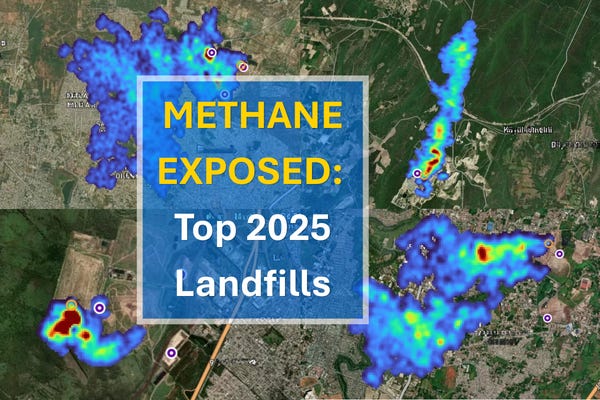
UCLA’s STOP Methane Project publishes user-friendly rankings of super-polluting methane emissions, including potentially responsible operators.
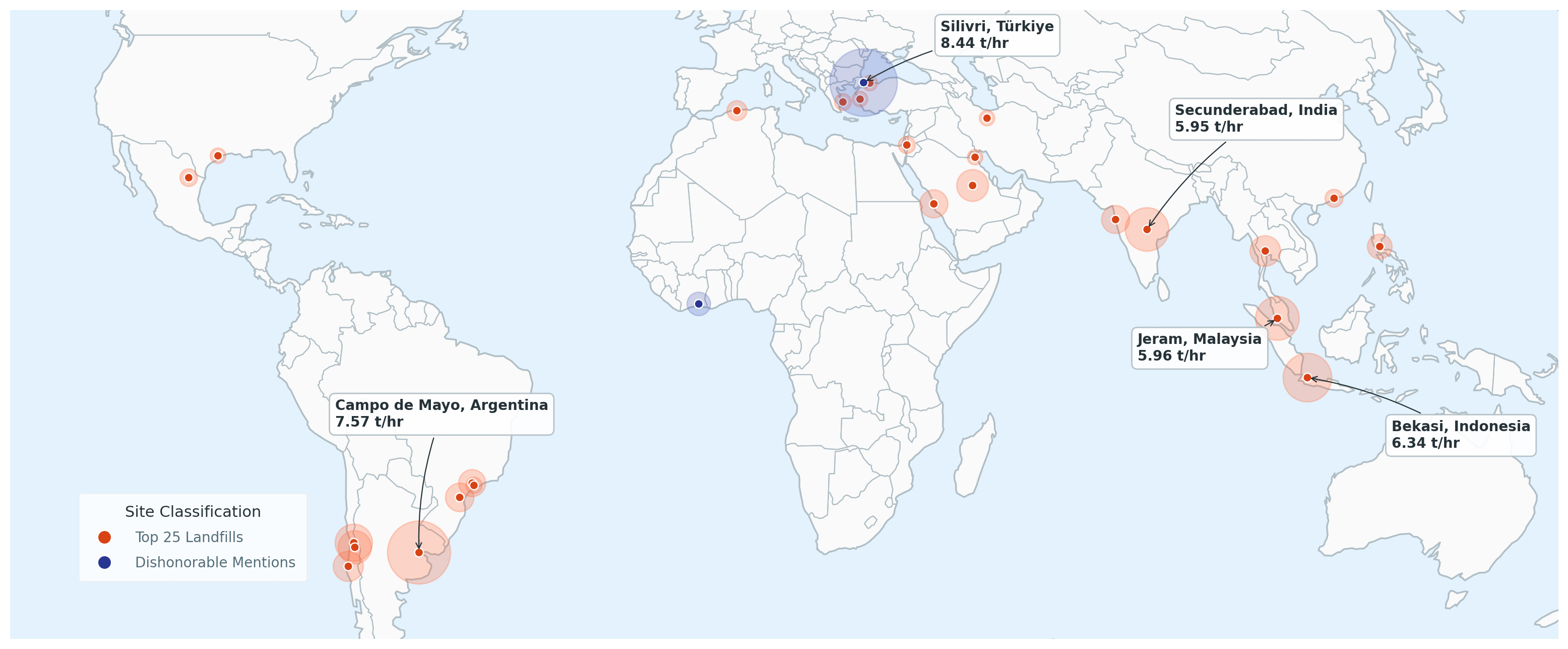
Brazil and Chile each have three landfills on the top 25 list.
The No. 1 site on the top 25 list is a landfill near Buenos Aires, Argentina with an emission rate of 7.6 tonnes of methane per hour — well over the global heating effect of one million SUVs.
Three of the largest methane plume sites are in Turkey, home of the next United Nations (UN) climate conference (COP31). The country pledged to reduce waste emissions ahead of the conference.
In addition to the top 25 sites, this release also includes two additional “Dishonorable Mentions” for landfills in Turkey and Ivory Coast.
UCLA’s STOP Methane Project released a new ranking of super-polluting methane emissions from the waste sector that includes three sites in Turkey, home to the next UN climate conference in November 2026. The report, “Spotlight on the Top 25 Methane Plumes in 2025: Landfills,” uses Carbon Mapper’s public data based on direct observations from 2025 to identify the waste sites with the largest quantified emissions rates worldwide — each site representing a major opportunity for operators to cut emissions.
The report ranks 25 waste facilities in 18 countries responsible for the largest super-polluting methane rates detected from space by key satellites in 2025. These facilities are found in developed and developing countries of all income levels and in all world regions, including: Brazil (with 3 sites), Chile (3), India (2), Saudi Arabia (2), Turkey (2), Algeria (1), Argentina (1), Greece (1), Hong Kong S.A.R. (1), Indonesia (1), Iran (1), Israel (1), Kuwait (1), Malaysia (1), Mexico (1), the Philippines (1), Thailand (1), and USA (1).
As organic waste breaks down it generates methane, a potent greenhouse gas. The waste sector contributes an estimated 20 percent of human-caused methane emissions globally. However, there are steps to collect and mitigate methane from the waste sector. Methane observation data can help find and fix leaks from landfills.
We are including a column titled “potentially responsible operator.” This information was not obtained directly from Carbon Mapper. Instead, the information is the result of research conducted by our team at the Emmett Institute.
For the first time, the list identifies two additional “Dishonorable Mentions” for waste sites with emissions rates that fall within our top 25 range, if observations since the end of 2025 are also included. These are sites near Istanbul, Turkey and Abidjan, Ivory Coast. This new data comes as Turkey prepares to host COP31, the next annual UN climate conference, and has launched an initiative to clean up its waste sector led by First Lady Emine Erdoğan. Notably, the landfill near Istanbul shows a larger emissions rate than any of our top 25 sites. (The data link for Silivri is here. The data link for Abidjan is here.)
“This list shows there is a lot of work to be done and not just by the COP31 host,” said Cara Horowitz, Executive Director of the UCLA Emmett Institute. “We are talking about seriously dangerous levels of methane coming from the waste sector in a wide variety of countries. Many of these sites sit close to cities, and their emissions pose real risks to public health. The good news is that governments and landfill operators can take practical steps to prevent these massive plumes.”
Identifying emissions of methane, one of the most potent heat-trapping gases, is easier thanks to satellite instruments that can detect methane from orbit. UCLA’s rankings are based on public satellite methane emissions data from the independent non-profit Carbon Mapper.
Researchers from UCLA’s STOP Methane Project analyzed data showing nearly 3,000 plumes from more than 700 waste sites worldwide to identify the Top 25 sites globally. These sites were responsible for the most acute hourly emission rates seen by the instruments worldwide – with emission rates ranging from 3.6 to 7.5 tonnes of methane per hour. To put that in perspective, a source emitting 5 tonnes of methane per hour (5,000 kg) would contribute about as much to global warming as one million SUVs.
Two landfill operators in Chile (Penco and Talagante) have already reported taking mitigation steps to address the methane emissions disclosed in the initial version of this 2025 list.
“We have already seen how making reliable data available to larger audiences and increasing visibility can be an effective way of prompting action,” said Juan Pablo Escudero, a project partner with UCLA’s STOP Methane and a Professor at Universidad Adolfo Ibáñez School of Law in Santiago, Chile. “This data provides great opportunities for responsible operators and national governments to lead the way on cleaning up their waste sectors.”
STOP Methane is a project of the UCLA Emmett Institute, a leading environmental law center in the U.S., which regularly releases user-friendly ranking lists of super-polluting methane emissions across multiple sectors, including oil and gas.
Read the full report